

PPWR, from regulation to industrial reality: ITP brings the conversation to Cibus Tec

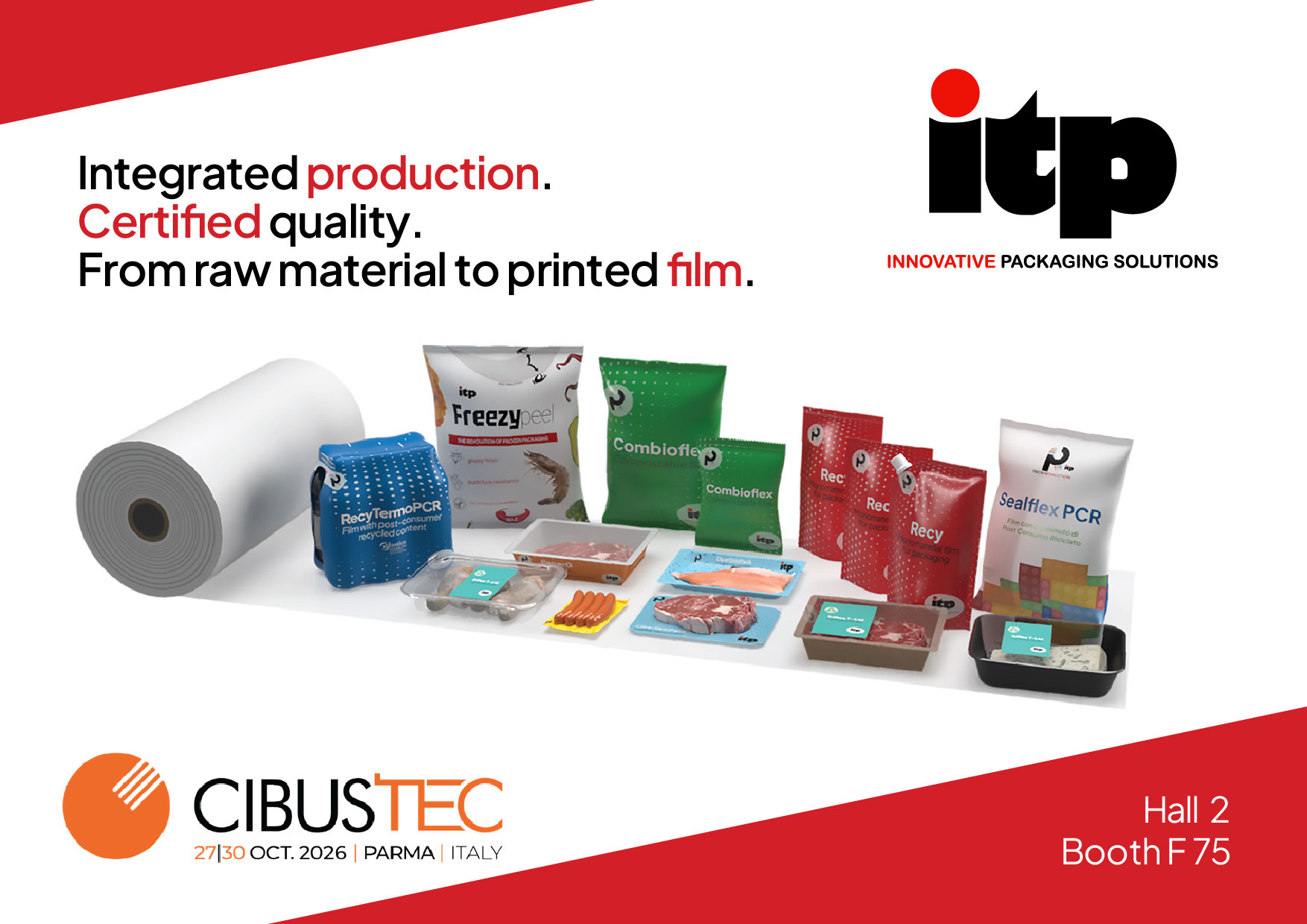
ITP is getting ready for Cibus Tec with new solutions, starting with Triflex T-Lid D4R, and a programme of meetings focused on the PPWR. A journey centred on innovation, testing and dialogue across the supply chain.
The PPWR is accelerating a transformation that is already underway in the packaging industry: recyclability, material reduction and the use of recycled content are shifting from broad objectives to increasingly concrete criteria in packaging design.
For food packaging, however, the challenge is not only regulatory. Above all, it is industrial: turning these objectives into solutions that can be effectively implemented, while maintaining the performance required by the product and ensuring efficient operation on packaging lines.
This is the perspective from which ITP is approaching the new European landscape, and it will be a key focus of the company’s presence at Cibus Tec 2026.
Starting with a discussion with General Manager Carlo Poggi, we explored what this transformation means today for companies designing and manufacturing flexible packaging: what requirements are emerging from the market, how development criteria are evolving and, above all, how the objectives of the PPWR can be translated into solutions that can be effectively industrialised.
This change is already clearly visible in customer requirements. The conversation is no longer simply about “more sustainable” films, but about thickness reduction, recyclability, the use of recycled material and new structures, with targets becoming progressively more precise and measurable.
The direction is therefore clear, but there is not necessarily only one way to get there.
Triflex T-Lid D4R: the circular evolution of top lidding
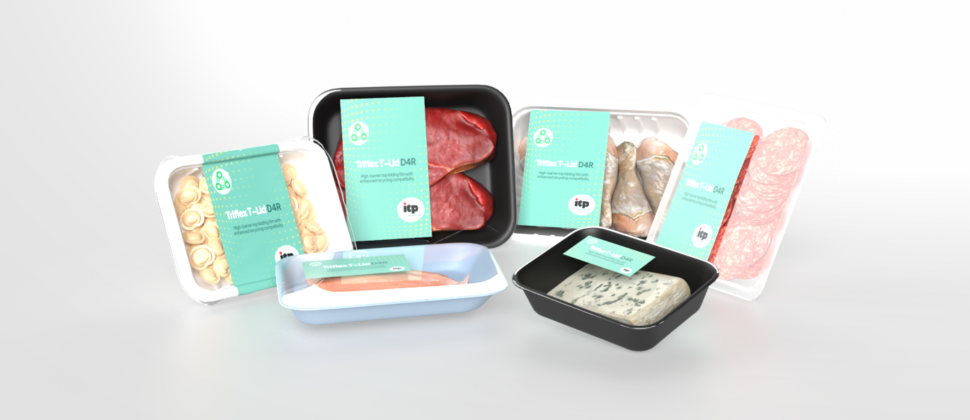
One of the solutions that reflects this journey is Triflex T-Lid D4R, one of the innovations ITP will present at Cibus Tec.
Triflex T-Lid D4R expands ITP’s range of high-performance top-lidding films with a new formulation developed to enhance compatibility with recycling processes, while maintaining the high performance required by the most demanding food packaging applications.
Produced using advanced Triple Bubble® technology, T-Lid D4R combines high barrier properties, stiffness, mechanical strength, transparency and sealing reliability in a coextruded monofilm structure, eliminating the need for lamination and enabling a thickness reduction of more than 30% compared with conventional solutions.
The new formulation falls within the Yellow Category for recycling compatibility according to the criteria of EN 18120-7, integrating Design for Recycling principles into the established Triflex technology platform.
T-Lid D4R therefore represents a further evolution of ITP’s portfolio, combining performance, resource efficiency and greater attention to the end-of-life management of packaging.
It is a solution that turns a broader principle into practice: evolving packaging does not mean focusing on a single parameter, but rather balancing different requirements within a structure that must, first and foremost, continue to perform its function effectively.
Not a one-size-fits-all solution, but the right solution for every application
T-Lid D4R therefore represents one of the possible responses to a challenge that, by its very nature, requires different approaches depending on the application.
“There is no one-size-fits-all solution,” says Carlo Poggi. Every project must start from the product to be packaged, the essential performance requirements, the characteristics of the production process, and the objective to be achieved.
Reducing the thickness of a tray lidding film, for example, does not simply mean using less material. It is essential to ensure that the packaging continues to provide the required mechanical strength, barrier properties, sealability and processability. Likewise, modifying a structure to improve its compatibility with recycling processes requires assessing its performance not only during the development phase, but also under real operating conditions.
There are several approaches that can be taken: downgauging, redesigning structures according to Design for Recycling principles, and incorporating recycled material, where the application allows. Increasingly, the most effective solution comes from combining several of these measures.
This is where the transition driven by the PPWR becomes, in practical terms, a process of innovation.
Being prepared means testing
Between defining an objective and bringing it to industrial scale, there is one crucial step: testing.
A new structure needs to be developed, sampled, tested and validated on packaging lines. Laboratory testing can provide essential insights into the film’s characteristics, but it is under actual operating conditions that the solution must prove its effectiveness.
For this reason, Carlo Poggi stresses that preparing for the PPWR means starting to test well in advance.
This process requires increasingly close collaboration between the film manufacturer and the customer. On the one hand, there is knowledge of the product to be packaged, the packaging lines and the process; on the other, expertise in materials, converting technologies and the development potential of new structures.
It is by bringing these areas of expertise together that the best balance between sustainability, functionality and industrial efficiency can be achieved.
The way of working within ITP is also evolving. Sales, R&D and production are becoming increasingly integrated, because sustainability requirements cannot be addressed separately from performance requirements and industrial feasibility.
From claims to measurable results
Another shift is taking place alongside the transition towards the PPWR: the growing importance of measurability.
Simply describing packaging as “more sustainable” is no longer enough. It is becoming increasingly important to describe and document the measures implemented: a reduction in the amount of material used, the inclusion of recycled content, or a change in the structure designed to improve recyclability.
This makes technical development more tangible while, at the same time, providing the entire value chain with more robust information to communicate the characteristics of new solutions.
Carlo Poggi sums up this transformation in three elements that will increasingly need to coexist in the packaging of the future: functionality, circularity and measurability.
These three concepts also help explain the purpose of ITP’s presence at Cibus Tec: not simply to present new products, but to create opportunities to discuss how to achieve the new objectives in practical terms and how to measure the progress made towards achieving them.
The discussion continues at Cibus Tec
The discussion will also be supported by the Digital Paper dedicated to the PPWR, produced by Largo Consumo for ITP, which will bring together analyses and perspectives from companies addressing the transition from different points of view.
It will provide a further opportunity to compare experiences and solutions and to move the discussion from regulatory requirements to industrial reality.
These same topics will be at the heart of ITP’s presence at Cibus Tec 2026. Every day, we will welcome companies and industry professionals to our stand to discuss the outlook for the sector and the different, yet complementary, approaches businesses are taking to prepare for the PPWR.
The meetings will offer an opportunity to discuss the practical implications of the Regulation, the strategies already being implemented to meet the new requirements, and the importance of collaboration across the value chain in achieving Europe’s new targets.
From the development of solutions such as Triflex T-Lid D4R to trials on production lines, from discussions with customers to the experiences we will share at our stand, the common thread will remain the same: turning PPWR objectives into concrete, measurable industrial solutions that can be effectively implemented.
PPWR Sessions at the ITP Stand
Session schedule currently being updated
📅 27 October 2026 | 11:00 – 12:00 AM
[Guest / Company]
[Session topic]
📅 28 October 2026 | 11:00 – 12:00 AM
Lorenzo Maletti / AB Mauri Italy S.p.A. Società Benefit
High-performance packaging and PPWR: the brand owner’s challenge
📅 29 October 2026 | 11:00 – 12:00 AM
Francesco Polano / AFG Packaging S.r.l
Lamination from a PPWR perspective: rethinking structures and processes
📅 30 October 2026 | 11:00 – 12:00 AM
Michelangelo Anderlini, Marco Silvestri / BIOPAP S.r.l. Società Benefit
Beyond Materials: Designing Packaging for the PPWR
The programme will be progressively updated with guests, topics and session times.
 24 July 2026